Vendor Distribution
Copy Article URL
Use Vendor Distribution when trusted recruiting partners should receive a job privately, submit resumes into Ovii, and operate inside the same governed hiring workflow as internal teams.
What challenges Vendor Distribution solves
Vendor Distribution exists for roles where internal sourcing alone is not enough. Instead of relying on fragmented email handoffs, off-platform resume sharing, or uncontrolled agency outreach, Ovii gives recruiters a governed way to let selected vendors work the same job inside the platform.
The feature solves a few practical problems at once: it reduces manual back-and-forth with agencies, keeps candidate source attribution intact, prevents vendors from seeing jobs they were not assigned, and brings vendor-submitted resumes into the same review workflow used for every other channel.
- Faster external sourcing: Recruiters can activate trusted partners quickly when internal reach is not enough for a hard-to-fill role.
- Less operational leakage: Instead of resumes arriving through scattered mail threads, vendor submissions enter the job in a traceable, structured way.
- Clear ownership and visibility: Only assigned vendors receive access, and recruiter teams can still see exactly which candidates came from the vendor channel.
- Comparable pipeline performance: Vendor candidates move into the same hiring system, making it possible to judge vendor quality against direct applicants, referrals, and recruiter sourcing.
How vendor distribution works in Ovii
Vendor Distribution is not a public promotion channel. It is a controlled partner access model where recruiters choose specific external vendors and allow only those vendors to work a role. That distinction matters because the vendor is not discovering the job through a public board; the recruiter is explicitly granting access to a private sourcing lane.
This model is strongest when a role needs specialist sourcing help, additional market coverage, or faster candidate generation than the internal team can create alone. It is especially useful for hard-to-fill positions, niche talent searches, or hiring campaigns where the company already has trusted agency relationships.
In Ovii, the vendor flow is intentionally structured end to end. Recruiters assign vendors to a job, vendors see the assigned role in their own workspace, vendors upload candidate resumes against that role, and the submitted candidates appear inside the recruiter pipeline with source attribution intact.
- Use it for governed partnerships: Vendor Distribution is appropriate when outside partners are approved sourcing collaborators, not when the company simply wants more public visibility.
- Keep attribution intact: Vendor-submitted candidates are tracked separately from direct applicants, referrals, and recruiter uploads so source performance remains measurable.
- Treat it as a workflow extension: Vendors contribute into the same operational hiring system, which means stage movement, review, and decision discipline still stay with the hiring team.
Before a recruiter can distribute a job to a vendor, the vendor organization and vendor user access should already exist in Ovii. Vendor setup itself is documented separately in Invite Team and Structure Access.
Enable Trusted Vendor Access for a job
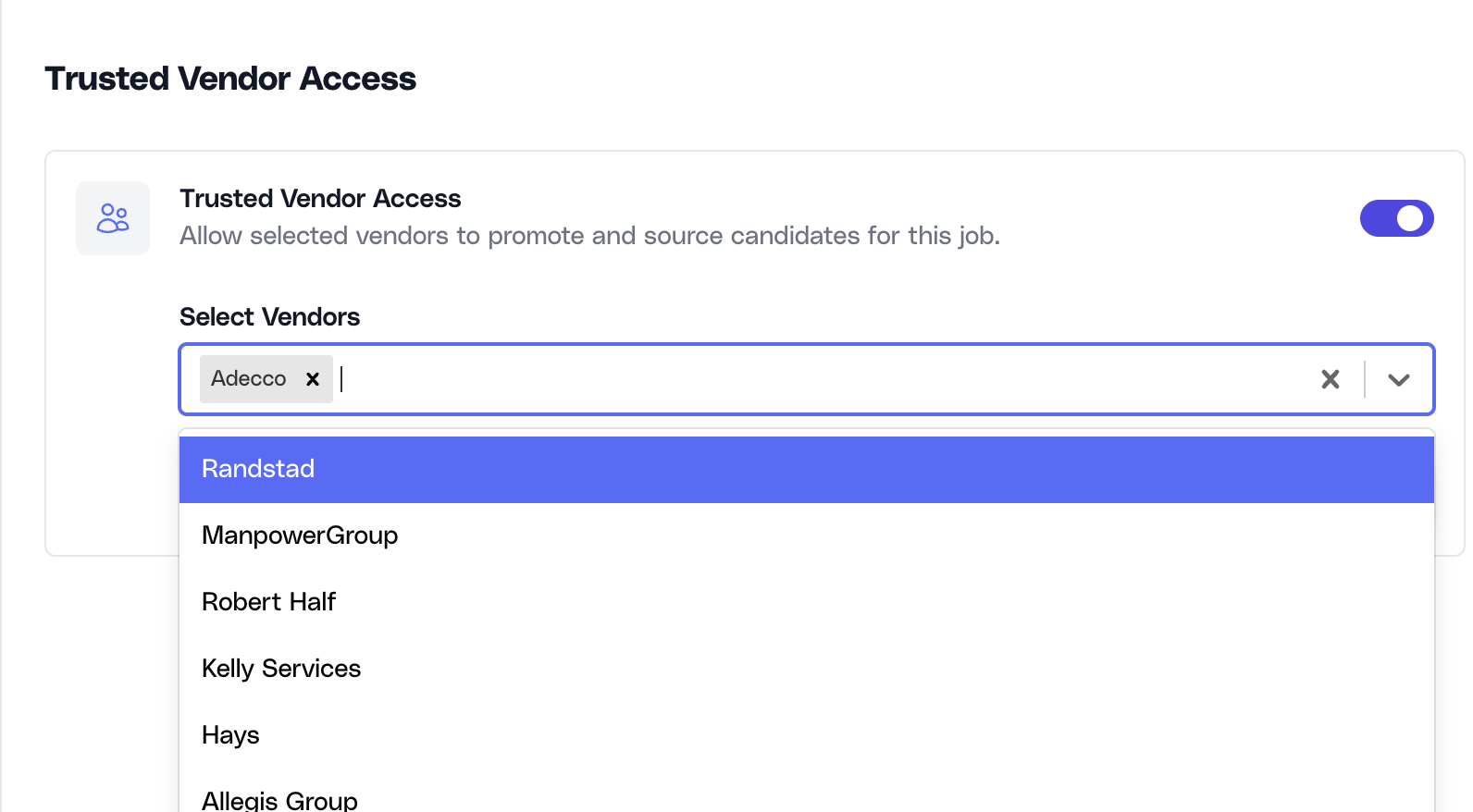
Recruiters enable vendor sharing from the Trusted Vendor Access card inside the Promote Job flow. This control does two things at once: it decides whether vendor distribution is active for the role, and it defines exactly which vendors are allowed to work the job.
The recruiter should turn this on only after the job itself is stable enough for external representation. Vendors are effectively an extension of the company’s sourcing motion, so title clarity, role scope, ownership, and screening expectations should already be ready before access is granted.
When access is saved, Ovii does not rebuild vendor assignment from scratch unless it has to. It compares the existing list with the new selection, removes vendors that were deselected, and adds only the newly selected partners. That is important operationally because recruiters can refine the partner list without creating noisy downstream resets.
- Selection is explicit: A vendor can work the role only if the recruiter has actively assigned that vendor to the job.
- Disabling the toggle matters: Turning vendor access off clears the assignment list and closes that sourcing path for the job.
- Assignment changes are audited: Enabling, disabling, and updating vendor access is recorded as a governed operational event, which is appropriate for an externally shared hiring channel.
Select only the vendors who should actively work the role
Open the Trusted Vendor Access card, turn the toggle on, and choose one or more approved vendors from the selector. If no vendors exist yet, Ovii directs the recruiter back to vendor setup first. Saving the card creates the private job-to-vendor assignment that powers the rest of the workflow.
In the current backend rules, enabling vendor distribution can be subject to subscription or promotion limits. Recruiters should treat vendor sharing as a managed sourcing resource, not an unlimited broadcast channel.
How vendors receive job postings
Once a recruiter saves vendor access, the job becomes available in the assigned vendor’s own Ovii workspace. Vendors do not need the recruiter to resend the role manually by email each time because the platform surfaces assigned jobs directly through the vendor-side job list.
This is a stronger operating model than ad hoc sharing. The vendor can open the assigned role, inspect job details, and work inside a dedicated environment that is already connected to the same hiring system used by recruiters. That means the vendor is not operating from a disconnected spreadsheet or inbox thread.
If a vendor is no longer meant to work the role, the recruiter can remove that vendor from the assignment list. From the vendor side, they can also remove the job from their own workspace without deleting the recruiter’s actual job. That separation preserves control for both parties.
- Vendor view is assignment-based: The vendor sees only the jobs explicitly assigned to that vendor account.
- Job detail is available to the vendor: The vendor can open the assigned role and review the job information before sourcing resumes.
- Removal is scoped: A vendor removing a role from their view does not delete the real job or affect recruiter-side ownership.
How vendors submit candidates
After opening an assigned job, the vendor can upload candidate resumes directly against that role. Ovii accepts PDF, DOC, and DOCX resumes, supports single or bulk upload, and processes the files asynchronously instead of forcing the vendor to wait on every downstream enrichment step in one blocking action.
That upload flow matters because vendor sourcing should feel operational, not informal. The platform queues the files, parses resume content, generates match scoring, creates search embeddings, and then converts those uploads into candidate records attached to the target job. This gives the recruiter a structured intake rather than an untracked attachment chain.
The vendor should use this flow only for real, role-matched submissions. Sending high-volume low-relevance resumes weakens the value of the channel and makes it harder for the recruiter to trust vendor throughput.
- Accepted file types: Vendor uploads currently accept PDF, DOC, and DOCX resumes.
- Submission source stays separate: Vendor resumes are tagged as VENDOR_UPLOAD, which preserves source-specific reporting and candidate ownership.
- Processing is asynchronous: Uploads are queued and enriched by the system before the final candidate records are available in the job workflow.
Vendor candidate deletion is scoped to resumes that the vendor uploaded for that job. A vendor cannot delete unrelated candidates or rewrite recruiter-owned records.
How vendor candidates enter the recruiter pipeline
Once processing completes, vendor-submitted candidates appear in the recruiter hiring table for that job with the source shown as Vendor. This is one of the most important operational details in the whole feature because it lets the hiring team see vendor traffic inside the same live pipeline as direct applicants, referrals, recruiter uploads, and other acquisition channels.
At intake, vendor candidates are normalized into the same initialized starting state the platform uses for other early-stage entries. That keeps the review queue consistent. Recruiters do not need to maintain a separate side workflow just because the source was external.
From there, the candidate can move through screening, assessment, interview, and later-stage decisions like any other applicant. The source remains visible, so the team can later judge whether vendor candidates are converting well enough to justify continued distribution.
- Visible source label: Recruiters see vendor-submitted resumes with the source label Vendor in the candidate table.
- Consistent intake behavior: Vendor candidates enter the main workflow in the initialized intake state instead of bypassing directly to a later stage.
- Comparable pipeline reporting: Because vendor attribution remains intact, the team can compare vendor conversion quality against other sourcing channels over time.
Governance for vendor distribution
The best vendor programs do not optimize for resume volume alone. They optimize for trustworthy partner behavior, relevant submissions, and measurable conversion into interviews and hires. Ovii’s vendor flow is built around that principle: explicit assignment, source attribution, scoped access, and downstream traceability.
Recruiters should review vendor performance through candidate quality, response speed, shortlist rate, and stage progression. A strong vendor relationship improves coverage without degrading recruiter focus. A weak one creates pipeline noise and hidden review cost.
- Do not bypass the hiring standard: Vendor-originated candidates should move through the same evaluation logic, feedback structure, and decision gates as any other serious applicant.
- Share jobs intentionally: Only assign vendors who are genuinely expected to work the role. Broad external distribution weakens accountability.
- Judge vendors on conversion, not just activity: The right question is whether vendor candidates progress well, not whether the vendor sent many resumes.
- Keep partner lists current: Update vendor assignments when ownership changes so only active, relevant partners continue receiving access.