Salary Benchmark
Copy Article URL
Use this guide to understand how Ovii generates salary benchmarks, why each benchmark section exists, and how to use the output as recruiter guidance rather than a fixed compensation verdict.
What salary benchmarking is for in Ovii
Salary Benchmark exists to give the recruiter a market-informed frame before the role goes live. It is not there to replace compensation policy, finance approvals, or leadership judgment. Its real value is in reducing compensation blind spots early, before the team starts attracting candidates with the wrong pay story.
In practical terms, the benchmark helps answer questions that recruiters ask every day: Are we roughly in market for this role? Are we paying like a service company while hiring for a product-company expectation? Is the role strong enough to justify a top-of-market range? What can we negotiate besides base salary if the candidate pushes on cash?
This is why the benchmark is best treated as a decision-support layer. It gives structure to compensation conversations, but the final number still belongs to your hiring strategy.
A useful mental model is this: JD Review improves the quality of the role narrative. Salary Benchmark improves the quality of the compensation conversation. They support each other, but they solve different problems.
Why Ovii asks for compensation inputs before opening the benchmark
In the create-job flow, the benchmark drawer is gated behind the core compensation fields. The current UI requires currency, minimum salary, and maximum salary to be entered first. That is an intentional product decision: it prevents recruiters from treating benchmarking as the starting point for compensation design.
The better practice is to enter an initial range from internal policy, budget, or prior hiring history, and then use the benchmark to test that draft against market logic. This keeps the recruiter anchored in company reality instead of outsourcing the entire compensation decision to AI.
One important nuance from the implementation: even though the form requires those salary fields before opening the drawer, the salary benchmark engine itself is driven mainly by role context, employer signals, experience band, currency, and the job description. In other words, the benchmark is not simply echoing back the numbers you typed. It is generating a market view from the role context and then helping you compare your planned range against that view.
What the benchmark engine actually uses
The salary benchmark engine is more structured than the UI suggests. It uses a role-aware input package that includes the job title, company name, experience band, currency, and parsed job description. The stateless preview also receives company and role context directly from the create-job form.
The engine then classifies the employer type, builds a market range, compares the role against peer employer categories, and returns recruiter-oriented guidance such as additional compensation patterns, factors considered, negotiation levers, and a narrative market analysis.
- Job title and experience band: These define the core pay level. A benchmark for a Program Manager II with 12–15 years of experience should not resemble a benchmark for a mid-level coordinator or IC role.
- Company name and inferred employer category: Ovii explicitly reasons about employer type such as TECH_GIANT, PRODUCT_COMPANY, GCC_CAPTIVE, SERVICE_COMPANY, or ENTERPRISE_MNC. That matters because market expectations change materially by employer category.
- Currency normalization: The engine normalizes currency before generation and formats all results as annual base salary, so the output is designed to be internally consistent even when role data comes from mixed form states.
- Job description and skills context: The engine looks for the scope of work, seniority cues, and skill demand from the JD. More strategic scope or high-demand skills support stronger pay logic than generic responsibilities.
- A location-agnostic benchmark frame: The current engine is intentionally location-agnostic rather than tightly city-specific. That means the benchmark is directional and strategic, not a hyper-local compensation calculator.
This location-agnostic design is important to understand. The benchmark is strongest when used to frame compensation posture and employer-type positioning, not when used as a precise city-by-city quote engine.
Read the recommended range as a story, not just a number
The top of the drawer is designed to answer the recruiter’s first question: what pay band does this role appear to justify in the market? The recommended section combines a contextual note, base salary guidance, and additional compensation patterns. Together, these form the compensation story recruiters should be prepared to tell.
This matters because candidates do not evaluate only the base number. Senior roles are often judged as a package: salary, bonus expectations, equity potential, and overall positioning relative to the employer type. A benchmark that says the base is top-of-market but also flags common variable components is telling you how the offer may need to be framed.
Start with recommended pay and compensation mix
Use the contextual note to understand why the market may price the role higher or lower, then review the recommended minimum, maximum, and market median together. After that, inspect the additional compensation section to see which non-base elements are commonly part of the package for this kind of role.
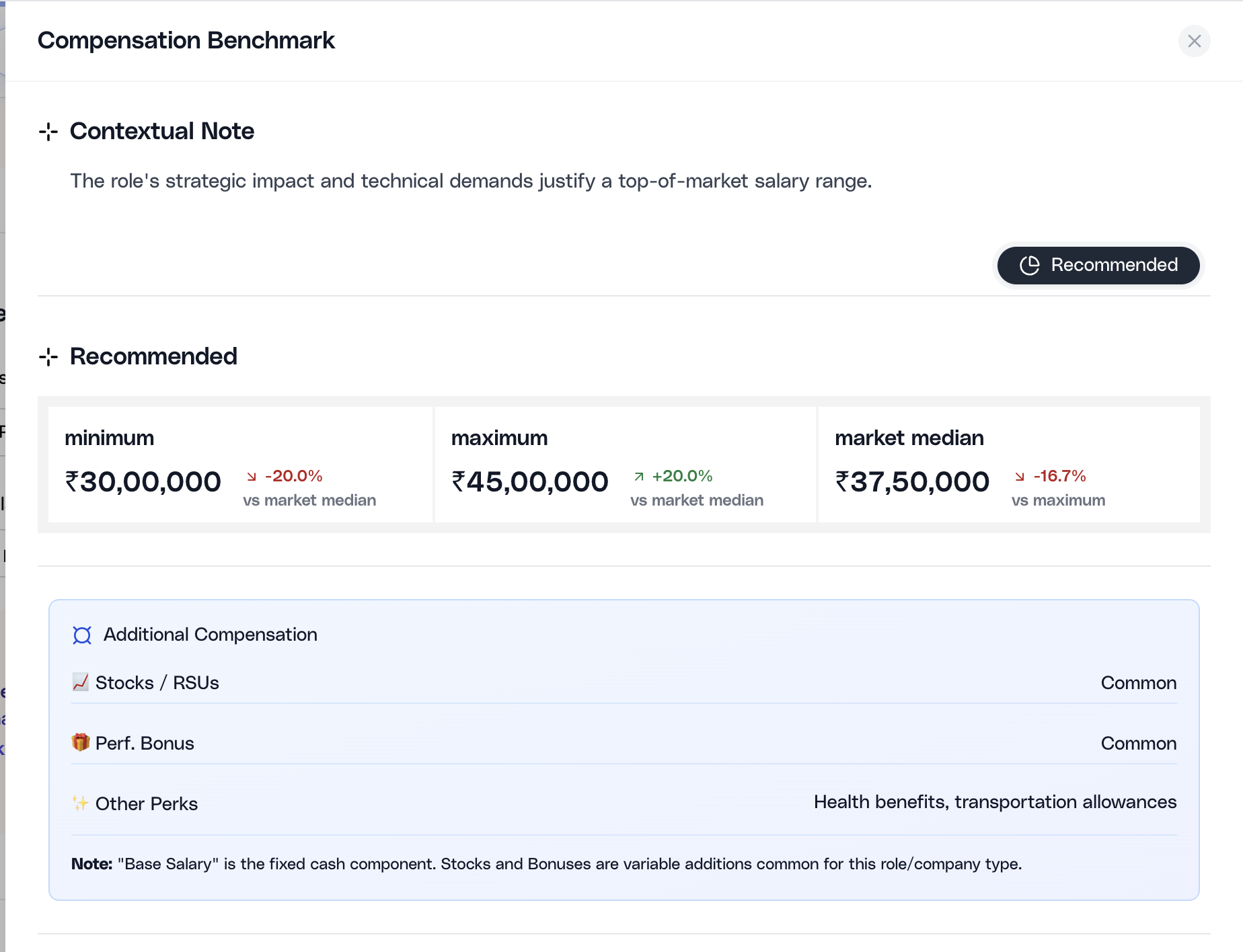
The salary benchmark engine explicitly treats all salary values as annual base salary. Stocks, bonuses, and perks are treated as separate compensation levers rather than hidden inside the base number.
Understand the factors considered before you trust the output
One of the most useful parts of the benchmark is the factors-considered section. Ovii does not want the recruiter to accept a number blindly. It exposes the actual reasoning signals the model used so you can judge whether the benchmark is anchored in the right facts.
This is good product design because it makes the benchmark auditable. If the listed factors do not sound like your actual role, that is a sign to revisit the title, experience band, or job description before using the benchmark in a real compensation conversation.
Check whether the benchmark is grounded in the right role signals
Review each factor and ask whether it truly reflects the role you are hiring for. Seniority, high-demand skills, leadership scope, and employer category should feel directionally correct. If they do not, fix the job inputs first instead of debating the salary output in isolation.

Use relative pay positioning for market context, not internal politics
The relative pay positioning section compares the role against different employer types. This is one of the most strategic parts of the benchmark because it helps the recruiter understand what sort of talent market they are stepping into.
For example, if the benchmark suggests your planned range aligns with a product company but sits below tech-giant expectations, that does not automatically mean you should raise the range. It means you need to be honest about which talent segment you are targeting and what trade-offs the company is prepared to make.
This section is particularly useful when hiring managers say they want top-tier talent while the budget is set closer to a mid-market employer posture. The benchmark gives the recruiter a neutral way to explain that mismatch.
Compare this role against peer employer categories
Read the positioning table as a market map. The point is not to win every comparison. The point is to understand whether the company is trying to recruit at service-company, product-company, or tech-giant expectations, and whether the proposed compensation posture matches that ambition.
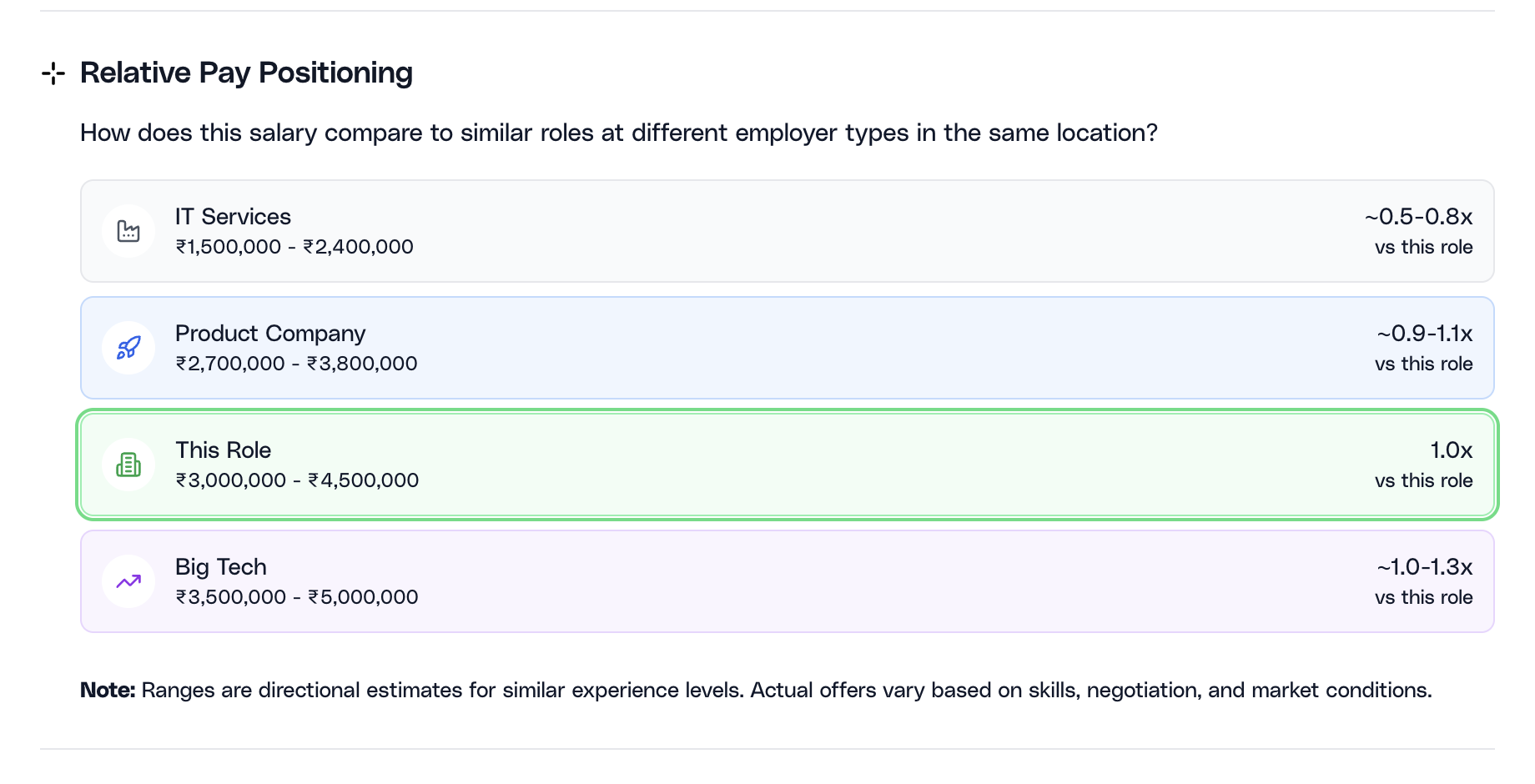
The salary benchmark engine uses a fixed peer comparison order so the recruiter can interpret the benchmark consistently across roles: service company, product company, this employer, and tech giant.
Read the market analysis like recruiter guidance
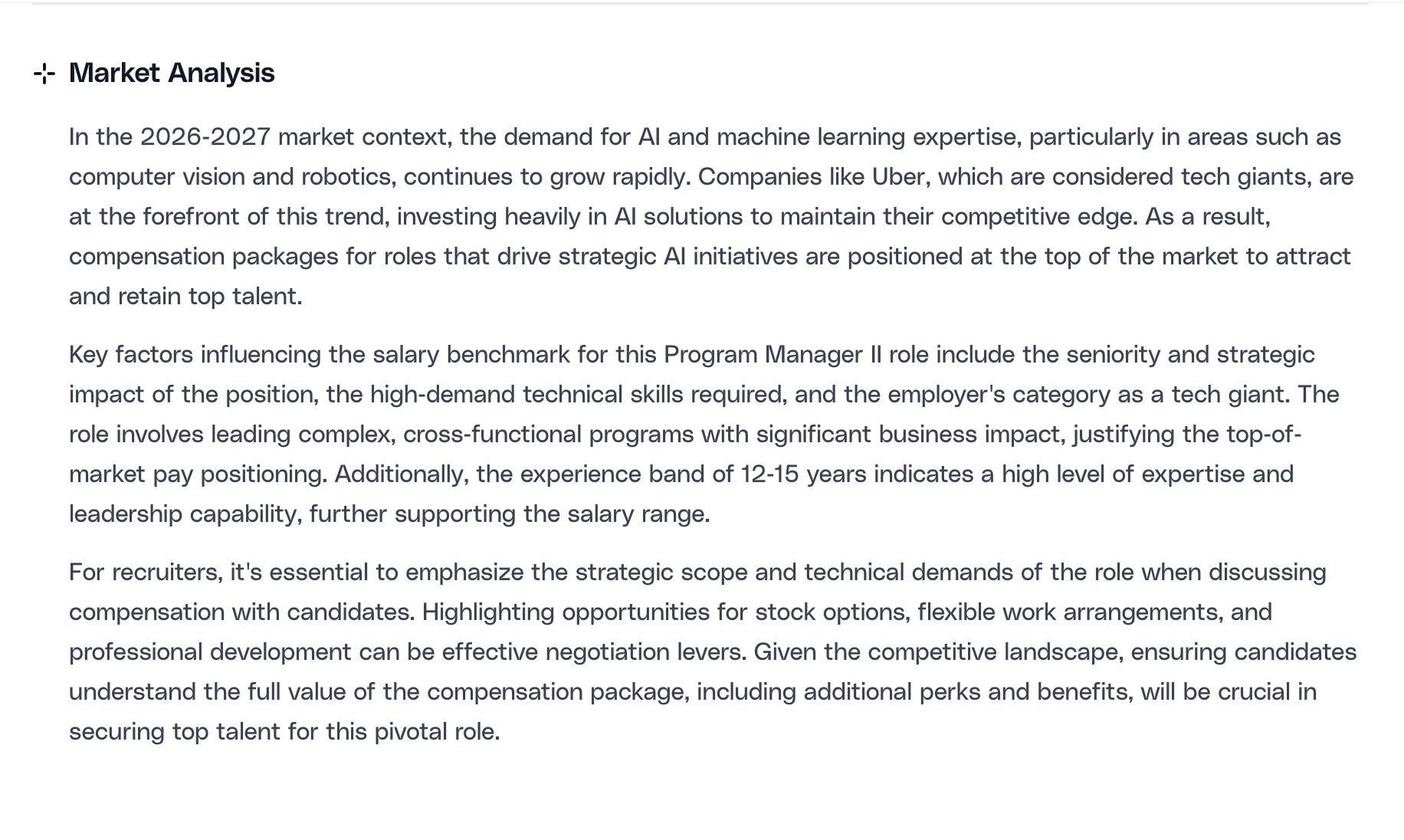
The narrative market analysis is not filler. It is the part of the output that translates raw benchmarking into a recruiter-facing explanation of the market. The salary benchmark engine is designed to return three narrative layers: market context, key factors, and recruiter advice.
That structure matters because recruiters often need more than a number. They need a story they can use with hiring managers, finance, and candidates. A good benchmark narrative explains why the market behaves the way it does and what that means for offer strategy.
Use the analysis to explain the market, not to overstate certainty
Read the market analysis as directional guidance. It can help explain why the role trends high, why certain skills push compensation upward, and where the competitive pressure is coming from. It should not be presented internally as a guaranteed truth or an external compensation report.
Use negotiation levers with care
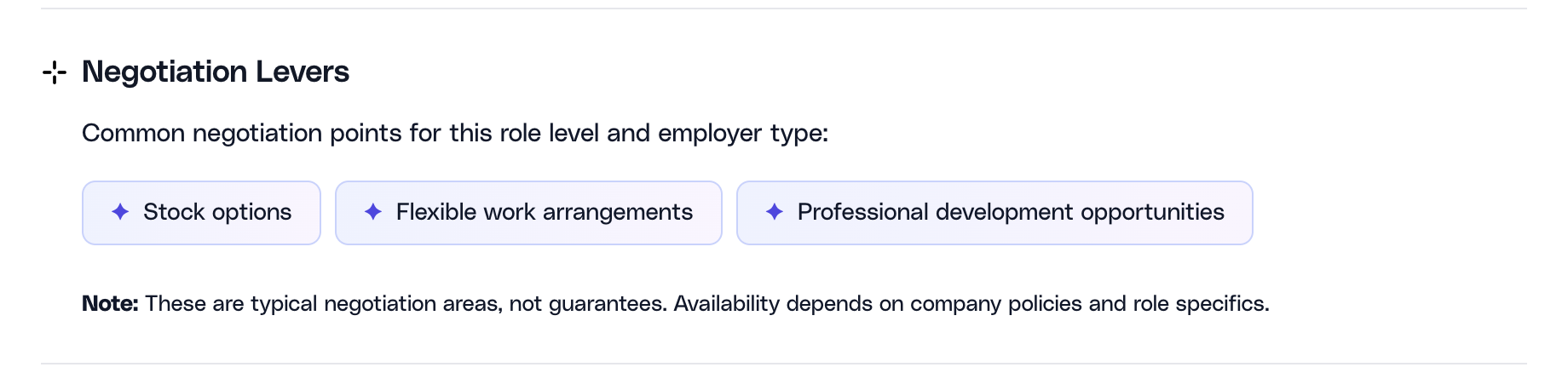
One of the better design choices in the salary benchmark engine is that negotiation levers are constrained to common, non-guaranteed levers for the role level and employer category. This keeps the recruiter focused on realistic offer architecture rather than improvising promises.
That matters because many compensation breakdowns fail not on the benchmark itself but on the final conversation. If cash is constrained, recruiters need to know what else is typically meaningful for this class of role: flexibility, learning opportunities, variable comp, equity, or other structure-based levers.
Treat levers as optional talking points, not commitments
Use the negotiation levers section to prepare for candidate conversations, especially when the offered base is near the middle rather than the top of the benchmark. These levers help frame total value, but they must always be validated against actual company policy before being used in negotiations.
Where human judgment still matters
Salary Benchmark is strongest when it helps the team make a better compensation decision, not when it is used as a substitute for compensation governance. Recruiters still need to account for internal pay equity, approved budget, offer approval paths, business urgency, and talent scarcity in the actual hiring lane.
A useful way to think about it is this: the benchmark tells you what the market may expect; your compensation framework tells you what the company can responsibly support. The recruiter’s job is to reconcile those two truths without misleading either the hiring team or the candidate.
- Use it to pressure-test pay posture: If your planned range looks materially off-market, the benchmark should trigger a discussion before the role goes live.
- Do not use it as a single-source truth: It is an AI-generated estimate produced by Ovii’s salary benchmark engine and public-pattern reasoning, not a binding compensation survey.
- Keep internal equity in view: A strong external benchmark still needs to be reconciled against existing employee pay and compensation philosophy.
- Use it to improve recruiter communication: The best outcome is not just a better number. It is a clearer explanation of why the role is priced the way it is.
The product disclaimer is not cosmetic. The benchmark is AI-generated guidance and should not be represented internally or externally as a guaranteed offer range or official market survey result.