Job Boards
Copy Article URL
Use Job Boards to publish a role to Ovii’s public marketplace, your company-branded careers page, or both. The two channels solve different distribution problems, and Ovii keeps them separate so recruiters can control reach without losing source clarity.
What challenges job boards solve
Job-board distribution exists for roles that need discoverability beyond internal sourcing, referrals, vendor outreach, or direct recruiter activity. It solves the top-of-funnel problem: getting a role in front of qualified people who would not otherwise encounter it through your existing network.
Ovii separates job-board distribution into two different surfaces because the business problem is not always the same. Sometimes the company wants broad public reach through the Ovii marketplace. Other times it wants a controlled, branded employer-owned page that reflects company identity and keeps the traffic tied to the employer brand. Treating both as one generic publish button would remove important control.
- Use Ovii Job Board for reach: This is the right channel when the company wants category discovery, public search visibility, and broad candidate traffic.
- Use Branded Job Board for employer identity: This is the right channel when the company wants roles to appear on a company-specific careers page with its own URL slug, branding, and story.
- Use both when justified: Some roles benefit from both a broad marketplace channel and a branded conversion surface. Ovii lets recruiters keep those decisions independent.
Understand the two job-board channels
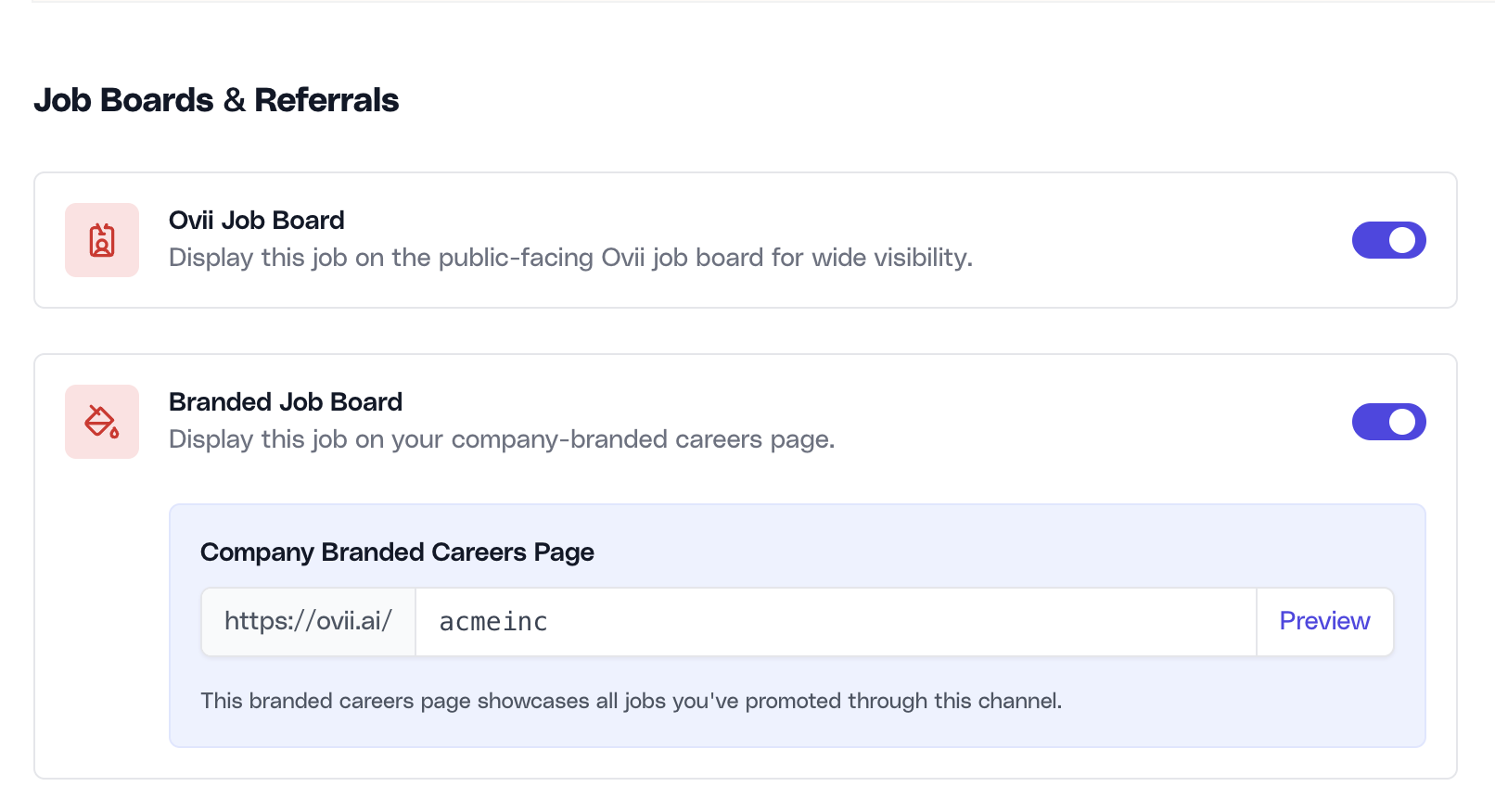
Ovii exposes two independent toggles in the promotion workspace: Ovii Job Board and Branded Job Board. They are not mutually exclusive. A recruiter can publish to one, the other, both, or neither depending on the hiring strategy for the role.
The Ovii Job Board toggle controls whether the job is eligible for the public Ovii board experience. That public board supports search, category grouping, featured jobs, and candidate-side filtering. The Branded Job Board toggle controls whether the job appears on the company careers page tied to the company branding slug.
This distinction matters because the visibility rules are different. The public board is marketplace-style discovery. The branded board is company-owned discovery. In both cases, the job must still be in a live state and not expired before it actually appears to candidates.
- Independent toggles: Turning off one board does not automatically remove the job from the other board.
- Shared live-state requirement: Both boards only surface jobs that are published or reposted and not expired.
- Different candidate intent: Candidates on the Ovii public board are browsing a broader market. Candidates on the branded board are intentionally engaging with a specific employer.
Publish to the Ovii Job Board
Use the Ovii Job Board when the role needs broad external visibility. This channel sends the job into the public board experience where candidates can browse by category, search by terms, and filter by employment type, location type, experience band, or recency.
Recruiters should think of this as a demand-generation surface. The role is no longer relying only on direct outreach; it becomes part of the broader candidate-facing catalog. That makes the quality of the job title, description, category assignment, and application route much more important because weak setup now affects a much larger audience.
The toggle is saved directly against the job as publishedToExternalJobBoard. When switched off, the role is removed from the Ovii job board even if the job itself still exists in the ATS. That gives the recruiter a clean way to stop public discovery without deleting the job or disturbing the internal workflow.
- Best for reach: Use this for roles that need wide discovery beyond the company’s own audience or brand-following candidates.
- Good for category browsing: Candidates can find the role through grouped categories, featured placements, or active search filters.
- Do not use as a test surface: If the job description or application path is still unstable, keep the role off the public board until the setup is clean.
Turn on the public board when the role is ready for broad discovery
In the Promote Job workspace, enable the Ovii Job Board toggle when the role is stable enough for public candidate traffic. This should happen only after core job details, application destination, and routing are correct, because the public board amplifies whatever the recruiter has configured.
Publish to the Branded Job Board
The Branded Job Board is the company-specific careers experience. It uses the company branding setup, especially the company URL slug, and shows only the jobs that the recruiter has chosen to publish to that branded surface.
This board serves a different conversion motion from the public Ovii marketplace. A candidate landing here is already engaging with your company specifically, not with the market generally. That means employer branding, page design, tagline, and overall role presentation carry more weight.
The branded toggle is saved independently as publishedToBrandedJobBoard. A recruiter can keep a job on the company careers page while removing it from the wider Ovii public board, or publish to both when the company wants maximum reach plus a consistent branded destination.
Confirm company branding and URL slug before using the branded board
If the company has not configured its branded careers slug in company branding settings, Ovii shows a warning instead of a usable branded-board destination. Once the slug exists, the recruiter can publish the job to the branded board and preview the careers URL directly from the promotion card.
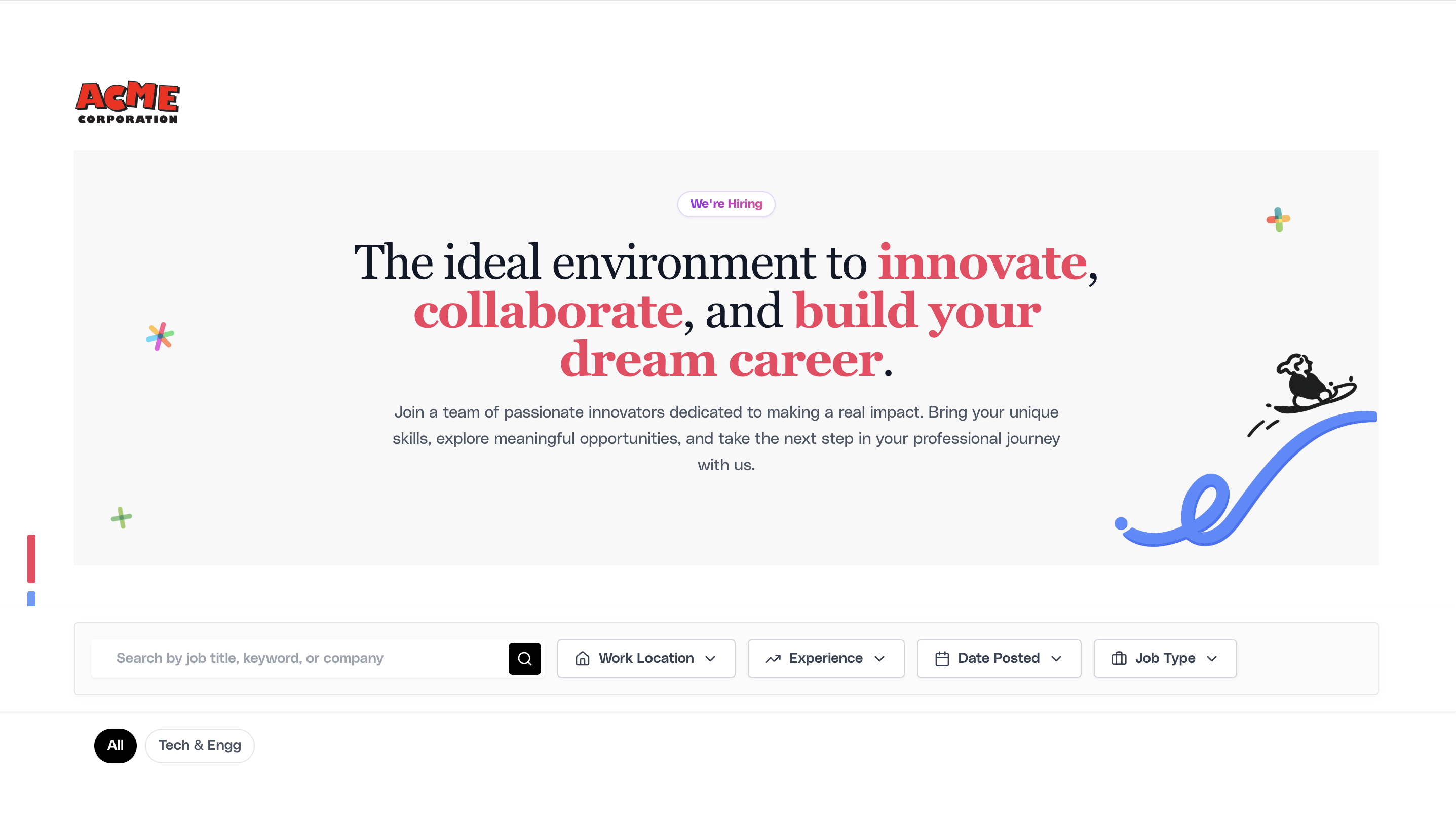
The branded board is the better choice when employer identity matters as much as raw reach. It is especially useful for companies investing in a coherent careers presence instead of sending all candidates through a generic job marketplace alone.
How candidates discover and apply from each board
Candidate behavior differs slightly by board. On the Ovii public board, candidates browse a broad marketplace with grouped categories, featured roles, search, and filters. On the branded board, candidates browse only the jobs for a single employer, with the company branding layer shaping the experience.
In both flows, the job detail view still matters because that is where the candidate decides whether to apply, save the job, or follow an external application route if the recruiter configured one. The recruiter should therefore treat publishing and application setup as one connected decision, not two separate tasks.
The current product supports both standard logged-in candidate apply behavior and a branded-careers public application path. Logged-in candidates can apply through the normal candidate flow, while the branded-careers stack also supports public resume upload handling for company career-page applications.
- Ovii public board candidate path: Candidates browse `/jobboard`, filter results, open the job detail, and apply through the normal candidate route or external URL if the job uses external apply mode.
- Branded board candidate path: Candidates browse the company-specific careers page using the company slug, open a branded job detail page, and then apply through the configured application flow.
- External apply scenario: If the job is configured for an external application URL, either board becomes a discovery surface and the final apply action redirects candidates out to that external destination.
How applications enter Ovii from these boards
Source attribution is one of the main reasons the two boards should be documented separately. Applications that come through the public Ovii board and applications that come through the branded careers path are not treated as the same source in the underlying system.
Public-board applications are associated with the JOB_BOARD_APPLICATION source, while branded-careers public uploads are associated with the BRANDED_CAREER_BOARD source. This distinction is strategically valuable because it lets hiring teams measure whether generic marketplace traffic or company-branded traffic is producing stronger candidates.
Once the application is accepted, the candidate still enters the job workflow in Ovii and can move through the standard pipeline like any other source. That means the board creates top-of-funnel traffic, but the ATS still owns the real evaluation and decision flow.
- Keep source intelligence: Do not collapse all public applications into one mental bucket. Ovii preserves whether the candidate came through the public board or the branded careers path.
- Use board data operationally: Source-specific conversion rates are what tell you whether the distribution strategy is working, not just overall applicant volume.
- Application routing still matters: Publishing only creates discoverability. Candidate quality still depends on application mode, job clarity, and downstream review design.
Monitor quality and adjust board strategy
The right way to judge job-board publishing is not by traffic alone. A high-volume board can still be a weak channel if it creates recruiter noise, low-fit applications, or poor progression through assessment and interview stages.
Recruiters should compare the public Ovii board and the branded board based on real downstream value: shortlist rate, interview conversion, candidate relevance, and overall recruiter effort. Sometimes the public board wins on reach, while the branded board wins on candidate intent and fit. The platform is designed so you can make that comparison deliberately rather than guessing.
- Use the public board for breadth: Keep this channel on when the job needs market-level discoverability and the funnel can absorb higher top-of-funnel volume.
- Use the branded board for intent: Keep this channel on when employer brand and company-specific candidate interest are likely to improve conversion quality.
- Run both when the role justifies it: For important or hard-to-fill roles, combining public reach with a branded destination is often the strongest overall distribution strategy.
- Turn channels off intentionally: If a board is no longer producing useful traffic, remove the job from that board without disturbing the internal role record.