Candidate Discovery
Copy Article URL
Candidate Discovery is Ovii’s flagship sourcing experience for finding hidden talent already inside your database. Instead of making recruiters think like a Boolean engine, it lets them describe the person they need in natural language, shows what Ovii understood, and returns ranked candidates who can be moved straight into a live hiring pipeline.
What challenges Candidate Discovery solves
Most resume databases become underused for the same reason: keyword search is fast, but recruiter intent is richer than keywords. Hiring teams do not think in exact string matches. They think in stories like “find engineers who built fintech systems,” “show me product marketers who can work with SQL and lifecycle data,” or “look for people who moved from services into product organizations.”
Traditional search struggles there. It misses adjacent language, overweights exact phrasing, and makes recruiters manually translate business need into rigid syntax. Candidate Discovery exists to close that gap. It lets recruiters describe the person they need in natural language, then turns that intent into a structured retrieval plan that the system can actually execute.
That is why this feature should be positioned as more than semantic matching. It is a recruiter intelligence surface: it understands role anchors, supporting concepts, exclusions, structured filters, and the difference between what is mandatory versus merely helpful.
- Find overlooked talent already in your database: The feature is designed for resurfacing candidates who would be missed by narrow keyword search or manual browsing.
- Let recruiters search in business language: Recruiters can describe role intent, transitions, seniority, or context instead of memorizing rigid search syntax.
- Keep interpretation visible and editable: Ovii does not hide the search logic. It exposes what it understood so the recruiter can inspect and refine it.
- Turn sourcing into workflow, not just a list: Once a strong match is found, the recruiter can move that person into the active job pipeline and continue the same evaluation flow used for other candidates.
Start with a natural-language search
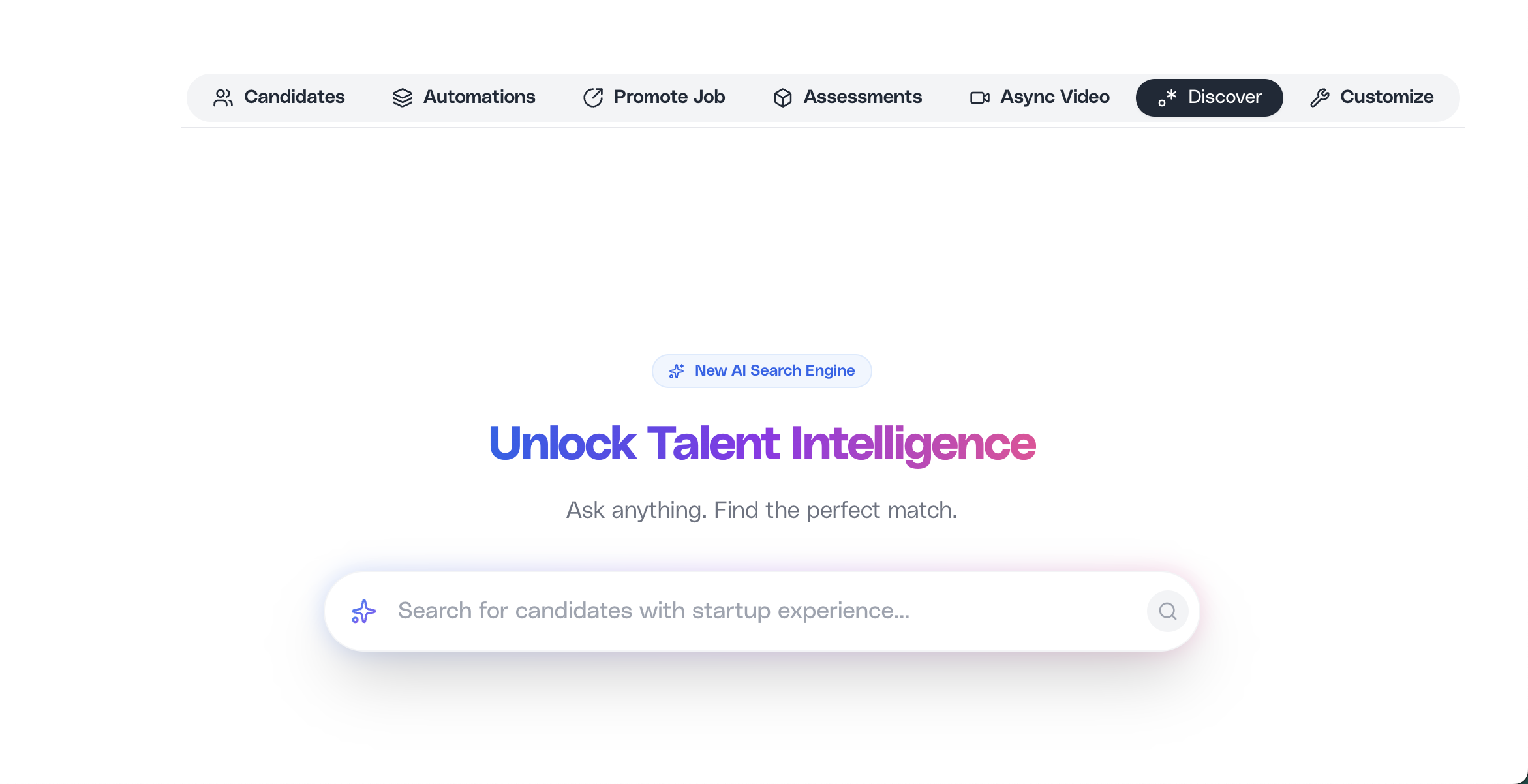
The search bar is intentionally built as an omnibar rather than a filter form. Recruiters can type what they are actually trying to hire for, such as role background, industry context, must-have skills, geography, or transition intent. The system accepts plain recruiter language because the engine is responsible for converting that language into a search plan.
This matters operationally. When a recruiter is under pressure, the hardest part is usually not typing keywords. The hard part is expressing the real hiring need clearly. Ovii reduces that translation burden and gives teams a better starting point than a brittle keyword query.
- Search by intent, not only exact terms: The engine is built to understand related signals, not just literal keyword overlap.
- Use real recruiter language: Queries can include industry, skills, level, transitions, exclusions, and location context together.
- Longer, clearer prompts are often better than shorter ones: The richer the recruiter intent, the better Ovii can separate role anchors from optional traits and hard filters.
Describe the talent you want to uncover
Use a natural-language prompt that reflects the real search objective. Include role anchor, skill context, domain signals, exclusions, or transition patterns if they matter. Ovii accepts the recruiter’s language first and handles the search translation layer for them.
Review what Ovii understood
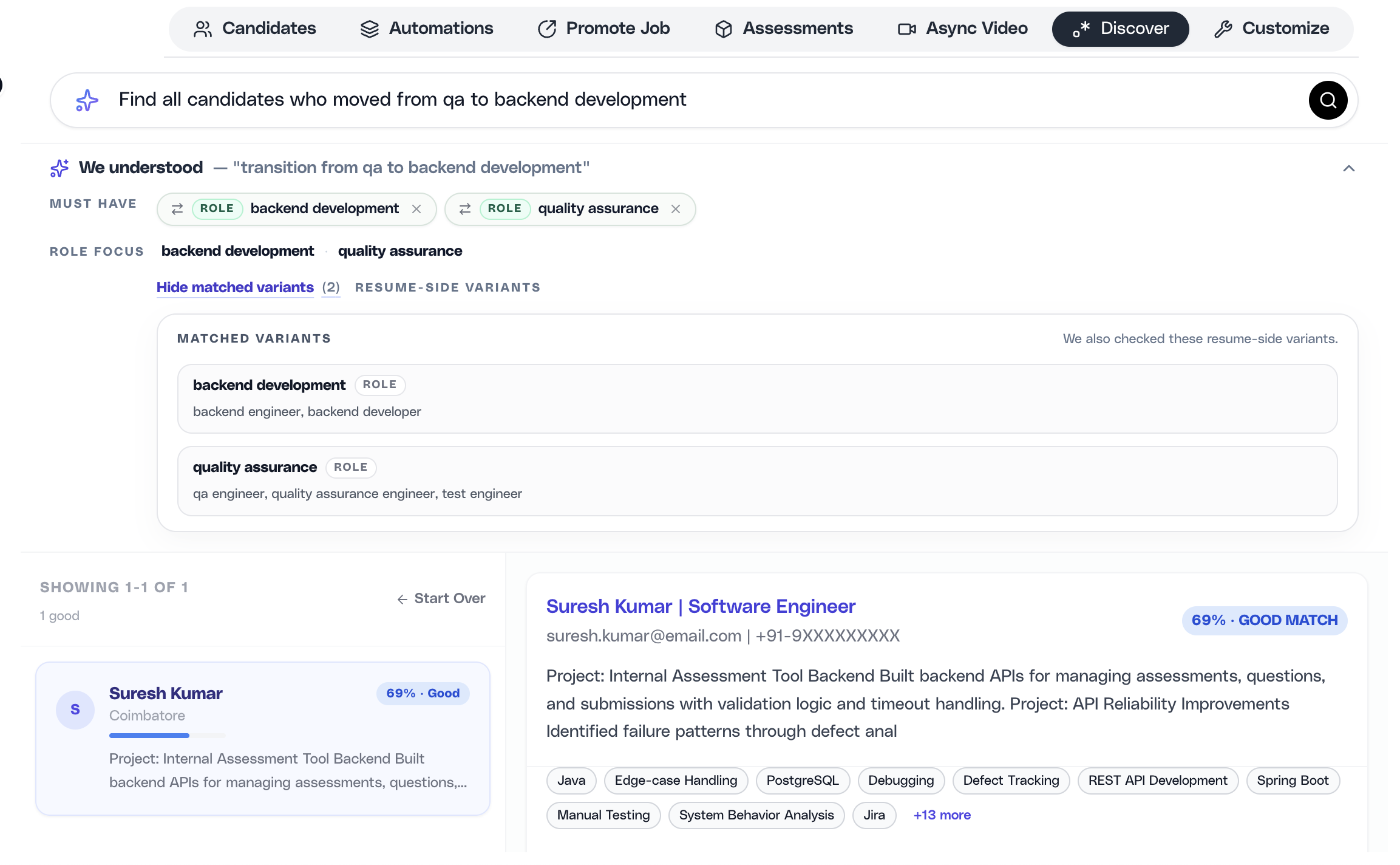
One of the strongest parts of Candidate Discovery is the interpretation layer. After a search, Ovii shows the structured search plan it derived from the recruiter’s query: what looks mandatory, what looks optional, what should be excluded, and which structured filters were applied. This is where the system earns trust.
The point of the “We Understood” view is not decoration. It is governance. Recruiters can sanity-check whether the engine interpreted the role correctly before they act on the results. If the engine inferred the wrong emphasis, the recruiter can refine the plan instead of starting from scratch.
From a product-story perspective, this is what separates a serious enterprise discovery tool from a black-box AI demo. The recruiter gets semantic power without losing auditability or control.
- Search plan structure matters: Ovii distinguishes must-have, should-have, any-of, and must-not concepts instead of flattening every search term into one bucket.
- Structured filters stay visible: If the engine derives filters such as experience or location constraints, those remain inspectable instead of hidden behind the scenes.
- Dropped filters are informative, not noise: When a filter cannot be applied cleanly, Ovii surfaces that fact so recruiters understand where precision may have changed.
Inspect the interpreted criteria and refine if needed
Review the search plan, applied filters, interpreted criteria, and any dropped filters. If Ovii overemphasized or underemphasized something, refine the plan directly and rerun the search instead of rewriting everything from zero.
Understand how results are ranked
Candidate Discovery does not return a raw vector score and ask the recruiter to guess what it means. Ovii applies semantic retrieval, post-filtering, deduplication, coverage-aware scoring, and match-band presentation so the recruiter can quickly understand whether a profile is a strong, good, or related match.
That ranking logic is important because enterprise sourcing is not just about similarity. A candidate may look semantically relevant but still fail on role anchor coverage, exclusions, or focus alignment. The ranking layer exists to keep the top of the list useful rather than merely interesting.
Recruiters should still read the results with judgment. The system is optimizing discovery quality, not making the hiring decision for them.
- Semantic retrieval finds broad candidate candidates: The engine first searches for relevant profiles using semantic concepts and embeddings rather than exact keyword overlap alone.
- Scoring adds hiring discipline: Candidates are then reranked and normalized into clearer match bands so the recruiter can prioritize effort quickly.
- Deduplication matters in real databases: Ovii cleans the result set so repeated or overlapping records do not dominate the shortlist.
Evaluate results with recruiter context
The result list is where discovery becomes sourcing judgment. Recruiters should inspect the ranking, read the AI summary, open deeper profile context where needed, and decide whether the profile is truly relevant for the active role rather than simply semantically adjacent.
This is where good search stories are made. A recruiter may search for a role anchored in one background and discover candidates from a nearby space who still satisfy the core problem. Candidate Discovery helps surface those profiles earlier, but human review still decides whether they belong in the funnel.
Review ranked matches and shortlist the strongest profiles
Use the returned results as a prioritized sourcing queue. Read the match context, inspect the candidate details, and decide which profiles are worth moving into active recruiting rather than treating the top-ranked list as an automatic shortlist.
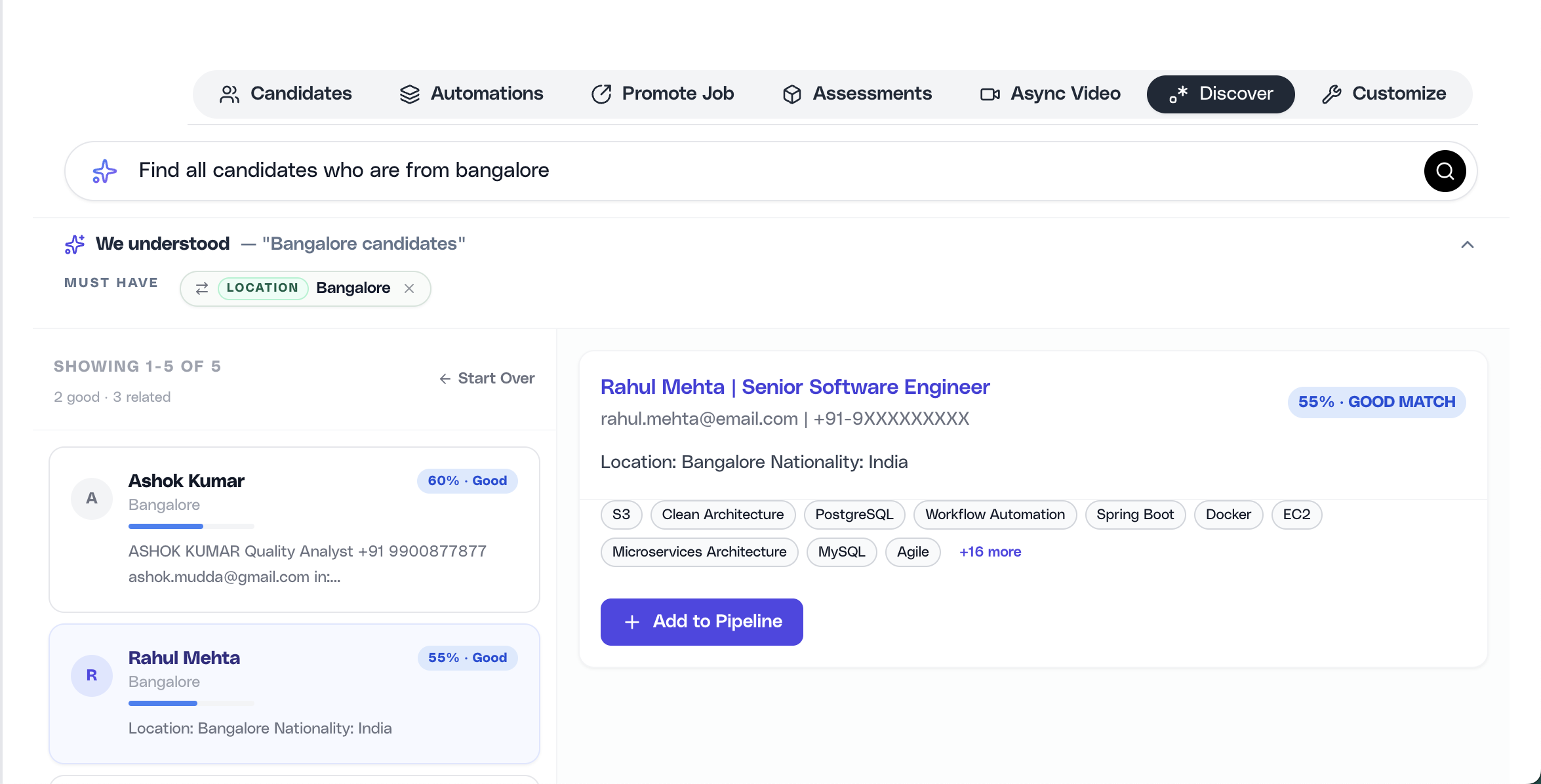
Candidate Discovery is strongest when recruiters combine semantic ranking with role context. A good match score is a prioritization signal, not a substitute for recruiting judgment.
Move discovered candidates into the job pipeline
Discovery only matters if it leads to workflow. Once the recruiter identifies a candidate worth pursuing, Ovii lets them add that person directly into the job pipeline. This is what turns search into operational hiring rather than leaving sourcing as an isolated activity.
After the candidate is added, the profile enters the same governed workflow as other pipeline candidates. That means the recruiter can continue with stage assignment, feedback, assessments, interviews, and hiring decisions in one consistent path instead of managing discovered talent separately.
- Keep sourced and inbound candidates in one system: Candidate Discovery should feed the pipeline, not create a side channel that later breaks process consistency.
- Avoid duplicate additions: Ovii checks whether the candidate is already present in the job pipeline before adding them again.
- Scoring can continue after pipeline entry: When a discovered candidate is added to a job, the system can trigger the same downstream job-context processing used for recruiter-uploaded resumes.
Where Candidate Discovery creates the most value
Flagship features earn their status by changing day-to-day recruiter behavior, not by looking impressive in demos. Candidate Discovery creates the most value when teams are sitting on a large resume pool, hiring for nuanced roles, or trying to revive talent that would otherwise remain buried in historical data.
It is especially useful for repeat hiring categories, scarce skills, and roles where adjacent experience matters. In those cases the recruiter may know what “good” looks like but struggle to reduce it to exact keywords. That is the gap this feature closes.
- Backfill or urgent hiring: Instead of waiting for new applicants, recruiters can search their existing pool immediately for people who already resemble the target role.
- Adjacent-talent discovery: The feature is strong when the best candidate may not use the recruiter’s exact vocabulary but still carries the right role, domain, or transition signal.
- Database reactivation: Candidate Discovery helps teams convert old resumes into a living sourcing asset rather than a passive archive.
Operating guardrails for semantic search
The best semantic search experience still needs recruiting discipline. Strong discovery outcomes depend on clear recruiter intent, careful refinement, and thoughtful shortlist decisions. The engine is powerful, but it should be used as a sourcing accelerator rather than an unquestioned oracle.
That is the right enterprise posture: trust the system enough to move faster, but keep human accountability where it belongs.
- Write real hiring intent, not vague aspiration: The engine performs best when the recruiter explains the actual role problem instead of using generic phrases like “great candidate” or “strong profile.”
- Use the interpretation layer before acting: If the “We Understood” panel looks wrong, refine it first. Do not shortlist against a search interpretation you already know is off target.
- Treat ranking as prioritization, not proof: The system ranks likely fits, but recruiters still need to confirm relevance, readiness, and fit for the specific job.
- Close the loop into the pipeline: The real value appears when discovered candidates move into governed hiring workflow rather than remaining in an isolated search result state.